
A number of my existing clients (and new clients) this year are having 8 figure liquidity events.
It is life changing money.
But many are young and new to investing which makes it hard and scary to get the funds into the market.
Most new investors do the same thing: wait for a "better" entry point.
Here's what actually works and the research I show them:
They wait for a dip or for the market to "calm down", and it feels responsible.
The research says otherwise.
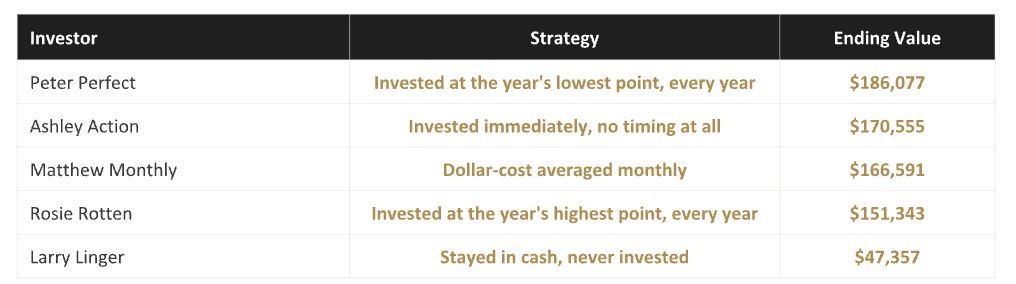
The Schwab Center for Financial Research studied five hypothetical investors who each received $2,000 at the start of every year for 20 years (2005–2024) and invested it in the S&P 500.
The only difference between them was timing.
Look at the gap between Peter (perfect timing, impossible to replicate in real life) and Ashley (zero timing). She just invested the moment she got the cash.
Over 20 years, Peter's edge was $15,522 (about $700 a year).
Meanwhile, Larry, who kept waiting for a better moment and never actually got in, gave up $103,986 compared to even Rosie, the worst market timer in the group.
Ben Carlson (an investment writer) tells the story of a hypothetical investor named Bob, who has the single worst timing luck imaginable.
Starting in the 1970s, Bob invests his savings once a decade and every time, he manages to invest right before a major crash.
Terrified after each crash, Bob stops adding new money for years at a time but critically, he never sells what he already owns.
He just keeps saving in cash until he works up the nerve to invest again, always at the worst possible moment.
Over his investing lifetime, Bob contributed a total of $184,000. He retired with a portfolio worth $1,100,000.
Takeaway: perfect market timing would of course help. But there is no way to do this. The difference between perfect and worst is not even that different. What we know is that you most likely won't get either of these and end up somewhere in the middle.
And that is okay. You still end up with a great return.
Most people use "dollar-cost averaging" (DCA) loosely to mean investing your paycheck surplus every month.
But that's technically lump-sum investing each time (you are investing money as soon as you have it).
True dollar-cost averaging is different: it's taking a pool of money you already have and deliberately spreading it into the market over 6–12+ months instead of investing it all right away.
So which wins? Historical analysis of 20-year rolling periods shows that investing a lump sum immediately has outperformed spreading it out via dollar-cost averaging roughly 71% of the time.
But DCA Isn't Wrong, It's a Trade-Off
If investing a large sum all at once would keep you up at night, or if doing so might tempt you to bail out the first time the market dips, spreading it out is a completely reasonable choice.
The data says lump sum wins more often, but only if you actually stick with it.
A plan you can emotionally sustain beats a theoretically optimal plan you abandon under stress.
Key point: DCA loses to lump sum most of the time because most years the market is up. However, the sharp decline hurts more than the increase helps the average person which is why most DCA after a large liquidity event.
Here's one of the most important statistics in all of investing research: just 3.7% of all publicly traded U.S. stocks have generated 100% of the net wealth created by the entire stock market over the last century.
The vast majority of individual stocks did little to nothing.
Many performed no better than holding cash in Treasury bills.
Broad diversification across company sizes, geographies, and asset classes solves this problem without requiring you to correctly predict the future.
If the market's next big winner is out there, an investor who owns the whole market already owns a piece of it.
I like to do this through direct indexing for most of these clients as you can get harvested losses to help offset gains from the sale + from earn outs coming.
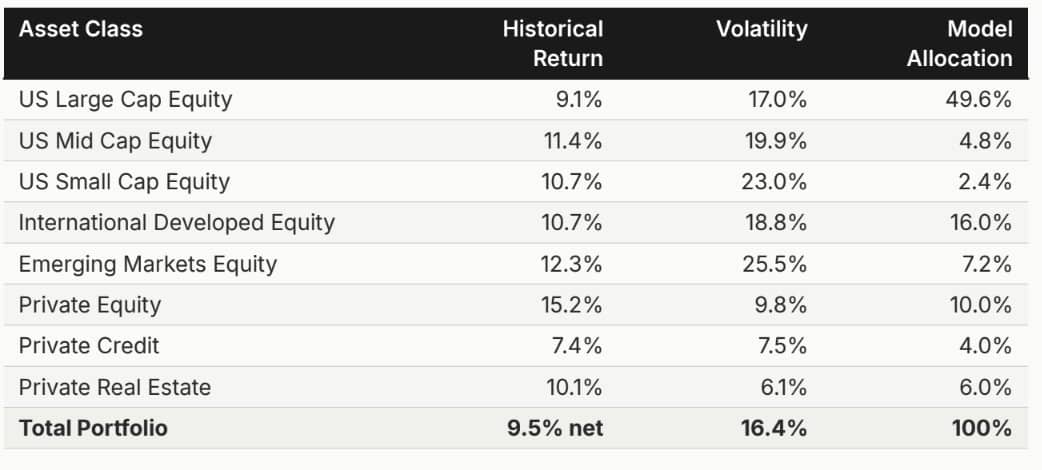
Major institutions currently forecast notably lower 10-year returns for U.S. large-cap growth stocks than for international and emerging markets, largely because U.S. large-cap has become expensive relative to earnings after a long run-up since 2010.
These forecasts might be wrong, they usually are, in one direction or another.
That's exactly why the goal isn't to guess which region wins next. It's to own all of them, so that whichever one does well, you are already exposed to it.
New investors often see the market drop 5–10% and panic, because they've heard the market averages "10% a year" and assume that means a smooth, steady climb.
It's nothing like that. Looking at data from 1928–2023:
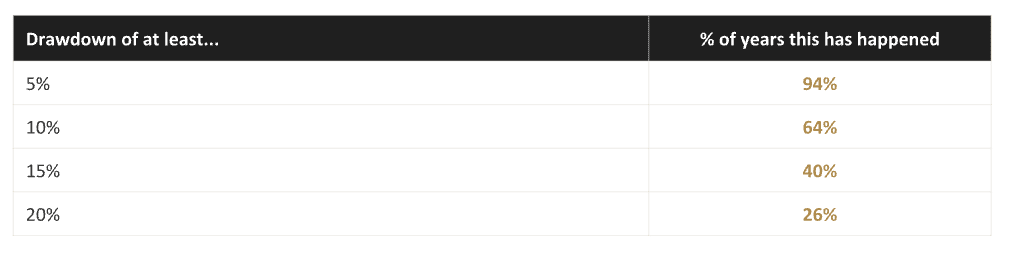
And yet, roughly 74% of calendar years still finish positive. The S&P 500 has returned an average of about 11% per year since 1950 and it has done so despite an average intra-year drawdown of around 14%, with plenty of individual years far worse than that.
Key takeaway: Stop checking your portfolio balance and the financial news every day.
Daily headlines are designed to grab attention, and fear sells better than calm. Almost nothing you'll read in a given week should change your long-term allocation. Checking less often isn't avoidance... it's discipline.
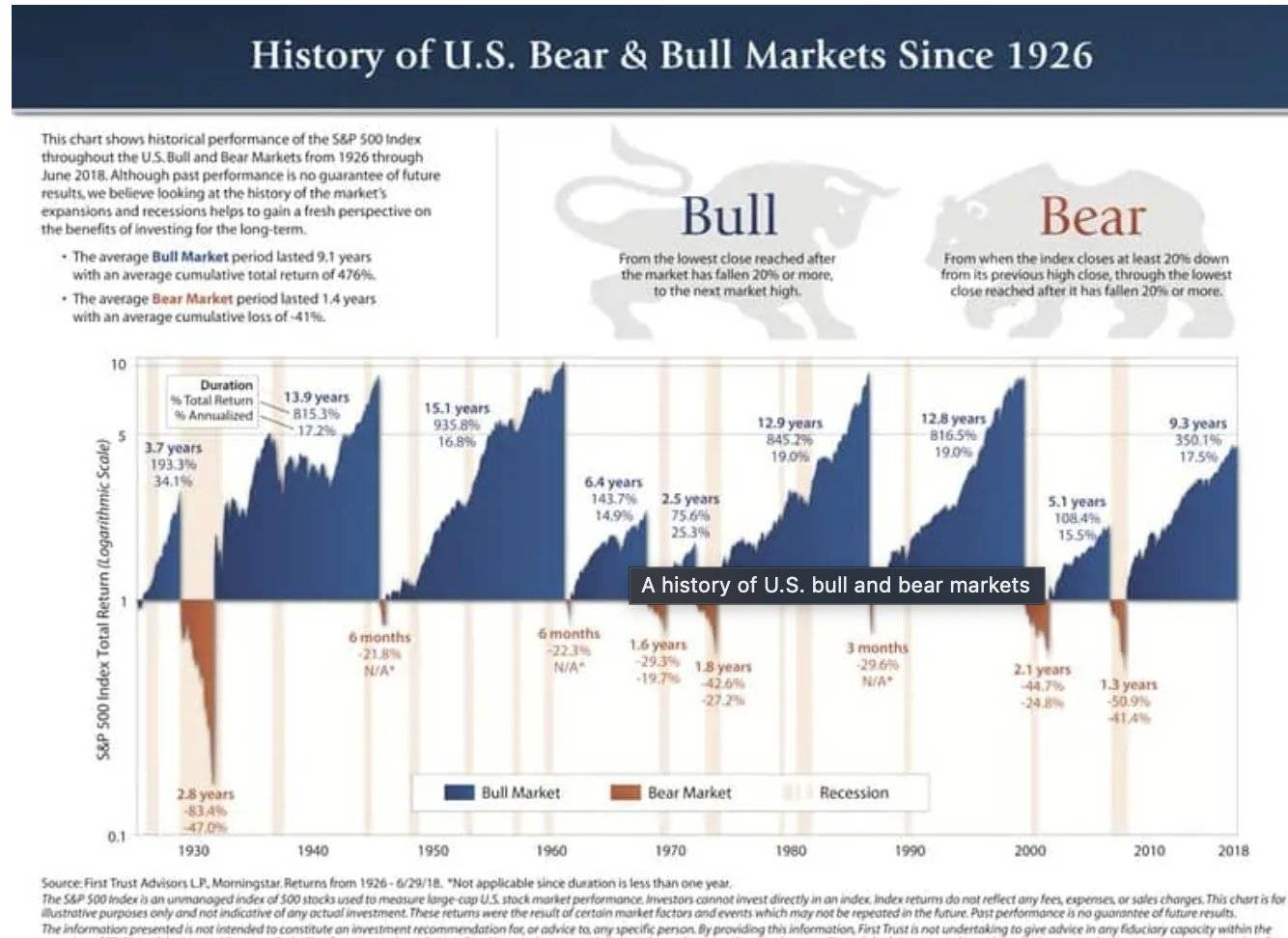
Since 1926, the average bull market has lasted about 9.1 years with a cumulative return around 476%.
The average bear market has lasted about 1.4 years with a cumulative loss around -41%.
Bull markets are both longer and, in aggregate, far more powerful than bear markets are damaging.
The problem is that nobody can reliably tell you which one is coming next. Plenty of experienced investors and institutions have confidently predicted recessions that never arrived, and missed the crashes that did.
That unpredictability isn't a flaw in the analysis. It's the nature of markets.
Since 1928, the list of reasons to sell everything and hide in cash has never stopped growing:
Through every single one of those events, the S&P 500 has compounded from around 10 (in 1928) to well over 7,400 today.
You'll see this play out in real time. In one recent stretch, tariff headlines pushed markets down about 3% in a single day, a weekend social media post reversed the move the following Monday, and then a follow-up statement sent markets back down again days later.
That kind of whiplash is exactly what headline-driven, short-term noise looks like.
And it has almost nothing to do with the long-term value of a diversified portfolio.
Knowing the research is one thing. Having a checklist for the moment your instincts kick in is another. Here's what we focus on when markets get rough:
The more educated you are and the more you understand markets, the better investor you can be.
It all starts there.

Financial Advisor